


Investor Relations leaders are facing the most challenging period in nearly two decades.
Geopolitical shocks, wars, energy insecurity, trade disruption, economic volatility, and a surge in activist campaigns all combine to create the toughest environment since 2008. In this climate, the quality of Investor Relations (IR) leadership is central to resilience and long-term value creation.
The insights shared in this paper are a culmination of our specialised industry knowledge, IR talent intelligence and a summary of in-depth conversations with 10 IR leaders across the FTSE 100 and FTSE 250 in sectors including: retail, construction, energy, industrial, consumer, and FMCG. Our discussions focused on understanding the latest challenges, trends, and whether the ideal profile for leaders in IR is shifting, and if so, how.
There is an emerging difference in how organisations are valuing the role of IR and the importance of its function when planning for their ongoing and future success.
Increasingly, our clients are discussing the potential benefits or risks of merging IR with Corporate Communications or even absorbing it into other remit areas, such as the CFO’s.
Growing recognition of the strategic contribution of IR
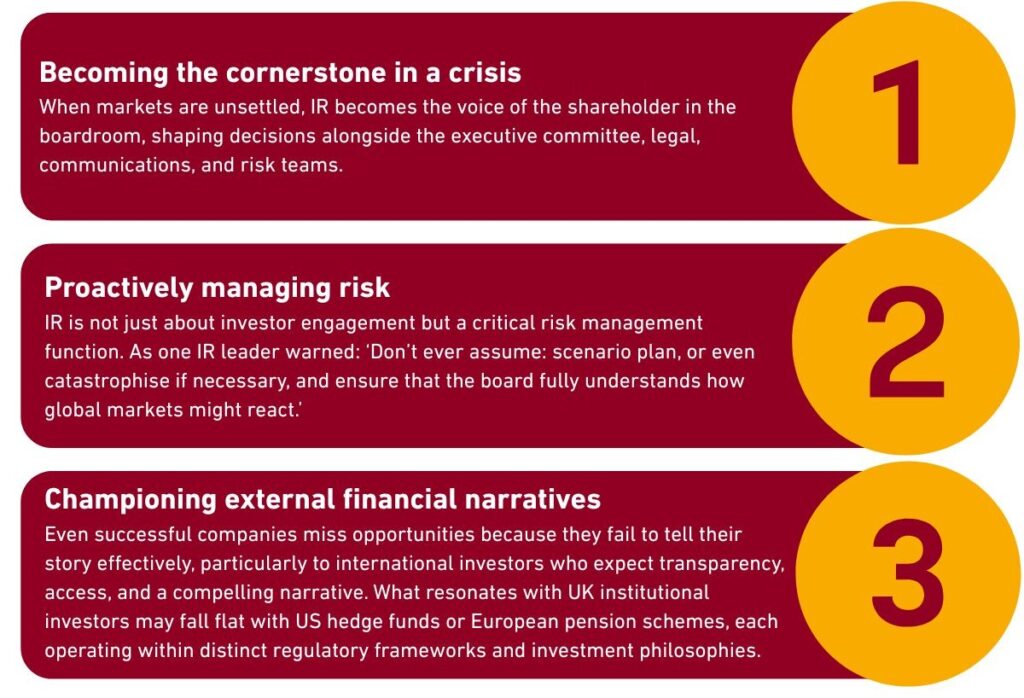
As an experienced FTSE 250 energy and engineering IR leader observed: ‘IR is the canary in the coal mine. In normal times, IR translates corporate strategy into investor trust. In a crisis, its role is elevated straight to the boardroom. One of the first questions is, what will shareholders think, and how will they react?’ This key moment of influence underlines the role of IR as a strategic partner and its ability to help shape the board’s response. ‘All of it matters: capital preservation, trust-building, damage control. Get it wrong, and the inbox is full within hours. Get it right, and you preserve credibility when it’s needed most.’
The IR leaders we interviewed unanimously agreed that the role has shifted from a reactive discipline into a strategic advantage. One FTSE 250 global security and engineering business described IR as now working,‘side-by-side with the board, CEOs, CFOs, crisis teams, corporate communications, and ESG teams,’ marking a significant shift from its once-siloed role. Crucially, IR now plays an educational role, helping boards understand how external markets actually perceive the company, often bridging a significant disconnect between internal boardroom perspectives and market reality. IR is often the first line of defence for reputation, and in some cases even involves coaching board members directly on the messaging they should use both externally and internally. This strategic evolution is further complicated by the need to navigate different international markets, each with distinct investor expectations and communication norms—requiring localised IR expertise in key markets such as the UK, Europe, and the US.
The message from every conversation was consistent: when done well, Investor Relations (IR) is not a ‘nice to have’ but a core driver of resilience.
We also observed that while IR’s role becomes more obvious in a crisis, sometimes its full potential isn’t sufficiently capitalised on during periods of growth. Strong IR leadership builds relationship equity. By investing in trust during stable times, IR leaders create goodwill that can be drawn upon in a downturn. This established credibility makes global investors more willing to stay supportive and back long-term strategies, even when short-term conditions are tough.
Why this matters to CEOs and CFOs
CEOs and CFOs are increasingly relying on knowledge gained from strong IR leaders’ relationships with their investor community to both translate market activity and convey the organisation’s story.
Our study highlighted three responsibilities that make IR indispensable:
IR joining the frontline of ESG communication
With boards accountable for Net Zero, diversity, and ethical governance, IR leaders must tell an authentic, evidence-based story. Investors and rating agencies demand facts, not slogans. At one FTSE 250, a strong central sustainability function enabled IR to frame ESG not just in terms of emissions reduction, but also as a commercial upside: better products, premium pricing, and long-term competitiveness. Today, the strongest IR leaders connect ESG to financial outcomes, ensuring consistency across sustainability reports, investor decks, and analyst calls.
Diversity of backgrounds is strengthening the IR leaders of the future
Traditionally, IR leaders have come from equities research within investment banks. While still invaluable, this background alone may no longer be a prerequisite. We are increasingly seeing an emerging trend of top IR talent coming from other areas such as financial planning and analysis, strategy, corporate communications, or corporate development, providing both credibility and broader strategic vision. The best IR leaders now blend:
Analytical depth: financial fluency, FP&A, or investment banking experience
Strategic breadth: corporate development, M&A, and board exposure
Communication credibility: trusted voice to investors, media, and colleagues
As one FTSE 250 IR leader stated: ‘It’s part numbers, part story. The skill is knowing what the market wants: combinations of modelling precision with a compelling narrative.’
Examination of the heads of IR with a background in finance
We analysed the 75% of IR leaders who have finance experience (in addition to IR experience) to understand the prevalence of different backgrounds among this population.

Utilising AI to streamline transparency with investors
AI is rapidly changing IR by driving productivity (drafting reports, analysing competitor disclosures, preparing FAQs) and offering investor intelligence (anticipating analyst questions with AI-driven models). When relied on too heavily, however, the risk of over-sanitising and de-humanising the data narrative should not be underestimated. Tone-deaf or inauthentic messaging as a result can lead to a costly loss of credibility with investors.
As one IR leader noted: ‘AI is hugely helpful in productivity and brainstorming, but it cannot replace credibility with investors.’
Those who harness AI whilst keeping the ‘human factor’ front and centre will define the next generation of IR.
The importance of IR for today and tomorrow
From our study, we see first-hand how Investor Relations plays a vital role in an organisation’s stability and, when properly leveraged, can play a pivotal role in securing shareholder trust and support in moments of adversity. Strong IR Directors are guardians of corporate credibility, translators of strategy into investor trust, and builders of relationship equity that cannot be created overnight. Boards, CEOs, and CFOs must treat IR as a strategic partner, investing in leadership talent and embedding IR at the heart of decision-making.
Three things are now clear:
IR is critical. The strongest Boards treat their IR leaders as partners in shaping strategy.
Previous requirements are broadening. Tomorrow’s leaders will emerge not only from investment banking, but also from financial planning and analysis, strategy, corporate development, and corporate affairs.
The stakes are rising. Market volatility and ESG demands require robust investor dialogue to protect valuations and funding access. Poor communication now carries immediate financial consequences.
Organisations that secure high-quality IR leadership will be better prepared to weather volatility, build trust, and achieve sustainable growth. Savannah Group partners with Boards, CEOs, and CFOs to identify and place IR leaders who combine technical excellence with strategic and reputational impact. We help our clients ensure their IR function is truly fit for purpose in today’s environment.
Please contact Hazel Lawrie for more information