


From geopolitical conflict and economic uncertainty to cyber threats, misinformation and the disruptive impact of artificial intelligence, leaders are increasingly being asked to make high-stakes decisions under conditions of extreme ambiguity.
Against this backdrop, a world-class panel of experts in politics, economics, national security and defence convened to explore what effective leadership demands in an era of persistent crisis and risk.

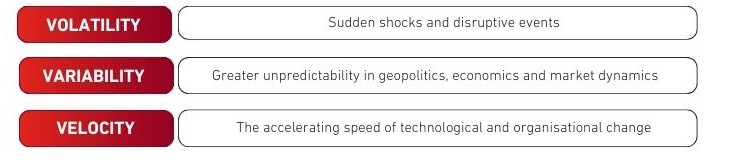
Throughout the discussion, speakers highlighted the ways in which these forces are already reshaping leadership decision-making, from the need to operate with incomplete information to the growing importance of resilience, agility and cognitive diversity to improve judgement and organisational decision-making.
The panel also agreed on something more fundamental:
“Periods of uncertainty don’t create leadership problems. They reveal them.”
Key themes from the discussion
VOLATILITY IS BECOMING STRUCTURAL
Geopolitical tensions, economic pressure, technological disruption and information instability are interacting in ways that make the business environment less predictable than in previous decades. Leaders are increasingly having to make decisions with incomplete information, under greater time pressure and while multiple risks are building simultaneously.
In this context, the expectation of relative stability between crises is becoming less reliable. Organisations are instead operating in a constant state of strategic adjustment.
For leaders, this means developing organisations capable not only of responding to shocks, but of operating effectively in environments where disruption is increasingly normal.
“Things are as unstable as they’ve ever been, and what happens next depends on how these events unfold.”
SCENARIO THINKING IS REPLACING LINEAR STRATEGY
Some organisations still plan around a single “base case”. However, the reality discussed in the room was that leaders now need to consider multiple possible futures rather than a single forecast. That means understanding what risks would force a strategic pivot, identifying early signals that scenarios are shifting and ensuring organisations retain the adaptability to respond quickly.
The leaders who perform best in volatile environments are often those who prepare operationally for uncertainty rather than trying to eliminate it.
“The issue isn’t predicting the future perfectly. It’s knowing what would trigger you to change course.”
CRISIS REVEALS THE TRUE STRENGTH OF LEADERSHIP TEAMS
One of the themes that came through strongly was that crises expose leadership weakness.
Periods of stress tend to reveal whether teams challenge each other effectively, whether decision-making is disciplined under pressure, whether leaders communicate clearly when uncertainty is high and whether organisations can adapt quickly when assumptions change.
Strong leadership teams tend to share several characteristics:
- Individual breadth of experience
- Collective clarity of purpose
- Cognitive diversity and constructive challenge
- Strong trust within the team
- The ability to make decisions without perfect information
In volatile environments, leadership team effectiveness becomes a central determinant of organisational resilience and a force multiplier in identifying and capitalising on opportunities when they come.
“Clarity of purpose becomes even more important when the wind is blowing in all directions.”
TRUST AND “RESILIENT TRUTH” ARE BECOMING LEADERSHIP ISSUES
A particularly striking part of the discussion focused on the information environment. The proliferation of misinformation, competing narratives and AI-generated content means organisations must increasingly think carefully about how they establish trusted information and shared understanding internally.
Without that foundation, decision-making becomes slower and more fragmented. For leadership teams, this means being deliberate about:
- What data is trusted
- How information flows through the organisation
- How leaders communicate clarity through uncertainty
“Facts matter. If we don’t know what information we can trust, we will make poor decisions.”
LEADERSHIP REMAINS A FUNDAMENTALLY HUMAN ENDEAVOUR
Despite the increasing role of technology, the discussion repeatedly returned to a simple point:
Organisational resilience ultimately comes down to people.
The Next Generation Leadership Institute has identified key capabilities and experiences that enable leaders to navigate volatility, velocity and variability.
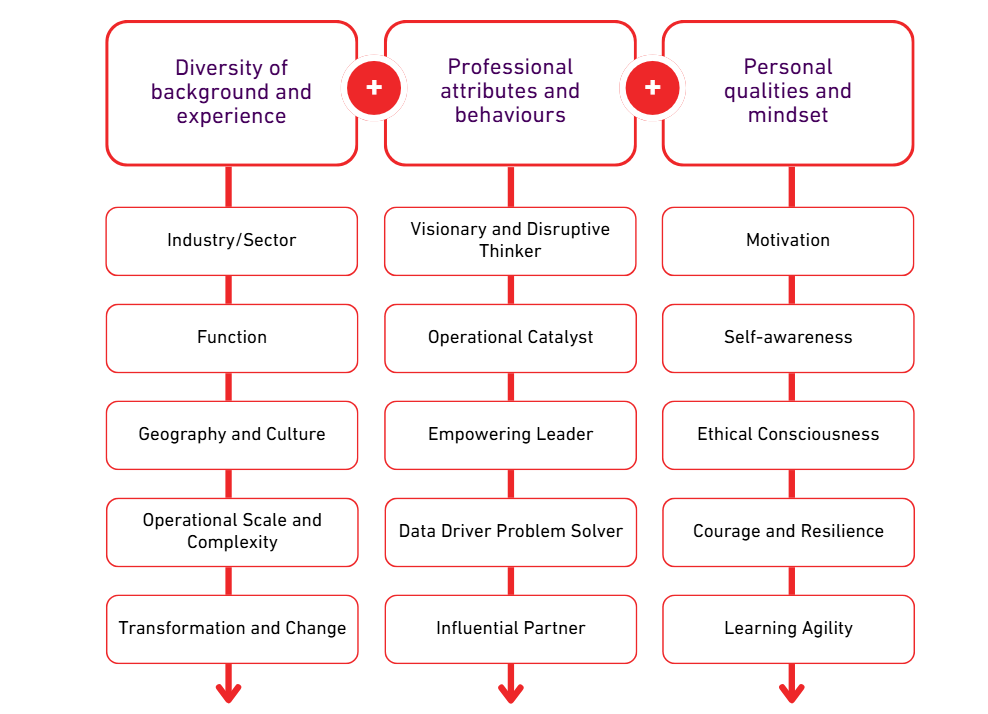
These capabilities do not appear overnight during a crisis. They are developed over time through improved team composition, more effective leadership development and greater diversity of experience.
“Leadership is a skill. Like any muscle, it can be developed.”
Leading in the context of The Three ‘V’s
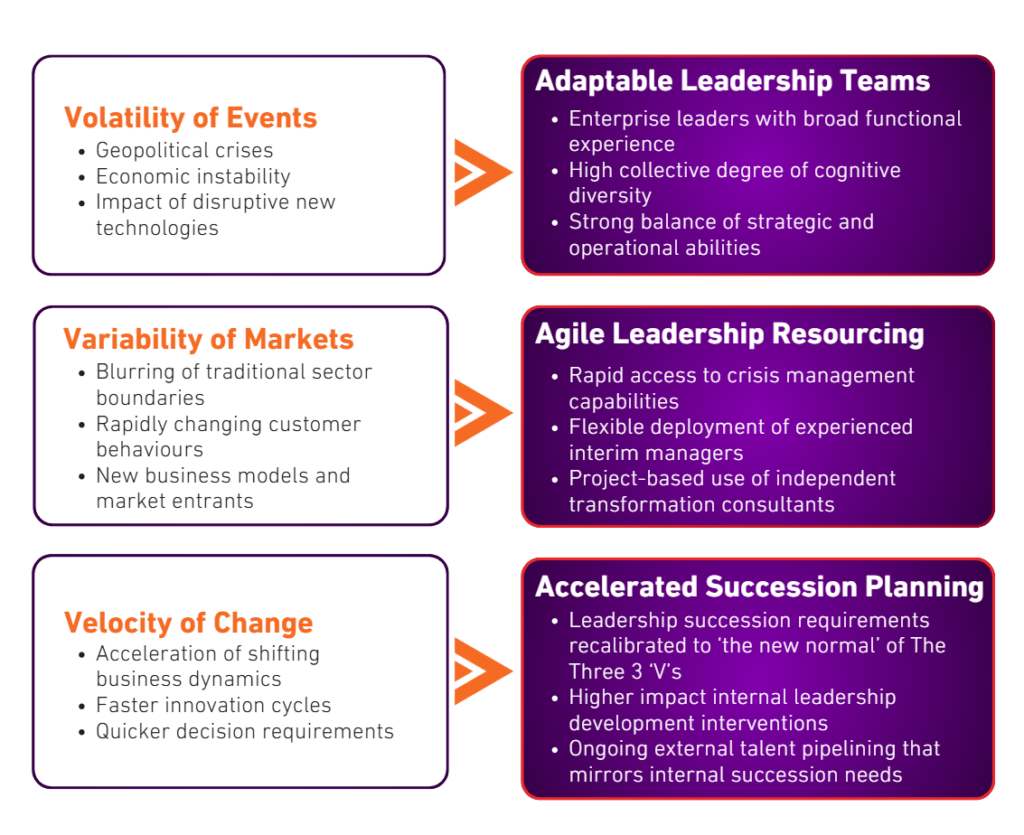
With volatility, variability and velocity as the defining attributes of the environment leaders now face, organisations need to develop three corresponding leadership capabilities.
ADAPTABLE LEADERSHIP TEAMS
When markets, geopolitics and economic conditions are less predictable, leadership teams must be able to adapt their thinking quickly.
This requires teams that combine cognitive diversity, strong challenge and debate and the ability to reassess assumptions as conditions evolve. Adaptability at the leadership level allows organisations to respond intelligently when the environment changes.
“You need a culture of inquisitiveness and curiosity, where people are willing to challenge assumptions.”
AGILE LEADERSHIP RESOURCING
Volatile environments create moments where organisations need new or better leadership capabilities quickly, whether to address a crisis, lead a transformation or stabilise a critical function.
Organisations are now structuring leadership resourcing to enable fast access to additional capability when circumstances demand it.
The ability to access immediately available specialist leadership talent can often determine how effectively organisations respond when unexpected events occur.
“The question is how well your organisation can respond to unexpected shocks.”
ACCELERATED SUCCESSION PLANNING
The speed of change in technology, business models and organisational structures is overtaking legacy succession models. Businesses need to anticipate the evolving requirements of existing leadership positions, together with the need for new roles in the future. They must ensure that the organisation has strong succession candidates using a combination of accelerated internal leadership development and agile external talent pipelining.
“In a fast-moving environment, future leadership readiness becomes a strategic advantage.”
The Leadership Resilience Framework
Conclusion
Successfully leading through crisis and risk will become the defining theme for 2026. Resilient, agile teams are crucial for navigating the next 12 months and beyond.
Savannah Group and Amicus Limited are working with boards and leadership teams to help organisations strengthen these three capabilities, building and developing leadership teams that are adaptable, resilient and ready for the environment ahead.
While the external environment continues to be volatile and unpredictable, quality of leadership will remain the single greatest source of competitive advantage. Our team is here to help https://savannah-group.com/contact-us/