


Over the past few months, we’ve heard from more than 30 CFOs across PE-backed and listed businesses. Almost none were losing sleep over this quarter’s numbers.
What concerned them was being ready for what comes next.
Today’s CFO is being pulled far beyond finance: into transformation, capability building, technology choices and leadership decisions that will define the next phase of the business. As a result, the question CEOs are now asking isn’t “How did we perform?” but something far more searching:
“What needs to fundamentally change in this business over the next 24 months — and what does that mean for finance?”
The strongest CFOs recognise the shift. They know that instinct and experience alone aren’t enough when the conversation turns to execution risk, leadership capacity and organisational readiness. Before committing to a strategy, they want confidence that finance — and the people running it — can actually deliver.
That’s where the pressure really starts.
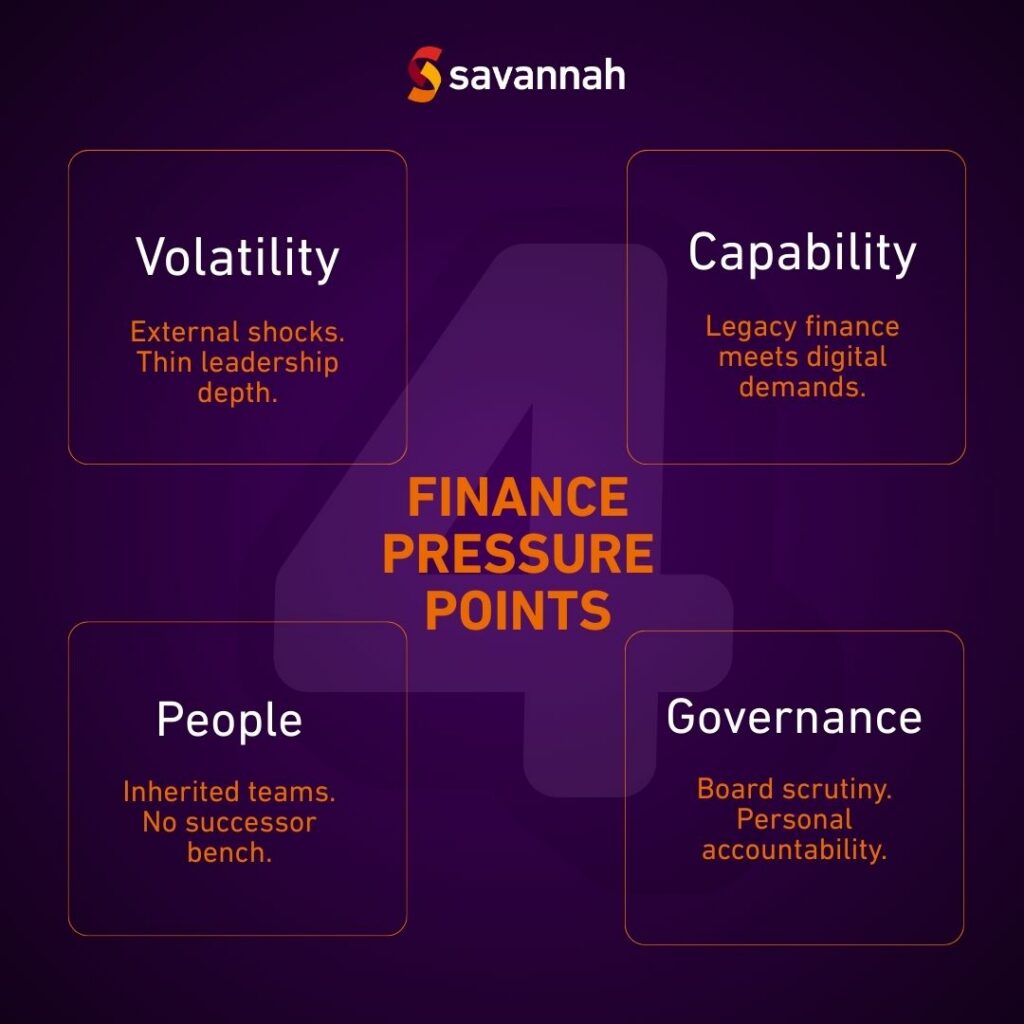
The four finance pressure points
Across sectors and ownership models, CFOs described the same four, tightly connected forces.
1. External volatility
Market instability, geopolitics, inflation, regulation, tax, supply chains and cybersecurity sit largely outside a CFO’s control. But their impact is shaped by one thing that isn’t: leadership capability. In volatile environments, weak decision-making and thin succession are amplified fast.
2. Technology and capability gaps
Many CFOs spoke candidly about legacy finance systems, accelerating transaction volumes, automation, and a shortage of genuinely technical finance talent. As one put it: “How many ACAs can actually code?”
CFO-1 and CFO-2 roles now demand transformation leadership, data fluency and systems thinking — yet many organisations are still hiring to yesterday’s specifications. The result is a growing capability gap inside finance functions, just as expectations are rising.
3. People risk
Nearly every CFO raised the same concern in different words: inheriting teams built for a different phase, living with historic hiring decisions, and worrying that today’s skills mix is designed for five years ago. Most lack objective external benchmarks to test these concerns. Without them, finance leadership becomes reactive — triggered by departures or crises rather than deliberate planning.
4. Governance and personal accountability
The modern CFO carries unprecedented personal exposure: audit sign-offs, historic contracts, regulatory scrutiny, board confidence and the integrity of financial reporting. Several CFOs spoke openly about the fear of a major issue emerging “on my watch” — even when the root cause pre-dated their tenure.
As a result, succession is no longer viewed as an HR exercise or a distant future concern. It’s a governance control. A lack of credible, ready successors increases risk precisely when scrutiny, transition or crisis hits — and when judgement and continuity matter most.
Responding to the four pressure points
Despite these pressures, many CFOs struggle to answer three deceptively simple questions:
- Who could step into my key finance roles tomorrow if needed?
- What capabilities will we be missing in the next phase of growth or transformation?
- How does my leadership team really compare to the external market?
Without external benchmarks, these remain assumptions rather than facts. And in volatile markets, assumptions are an expensive luxury.
Increasingly, CFOs want evidence long before any hiring decision is made.
Our work increasingly begins with a Finance Leadership Health Check: an independent, relatively low cost external view of finance leadership capability, succession readiness and market alignment.
It gives CFOs:
- Clear external benchmarks for senior finance roles
- Visibility into capability gaps and emerging risks
- Early warning signals on succession and leadership exposure
- Practical options: develop, redesign, supplement or replace
CFOs consistently tell us that having this clarity transforms the quality — and success rate — of subsequent hiring and succession decisions.

We’d welcome an initial no obligation conversation to share what we’re seeing across the market in terms of finance readiness — and to explore what that could mean for you. Reach us here