

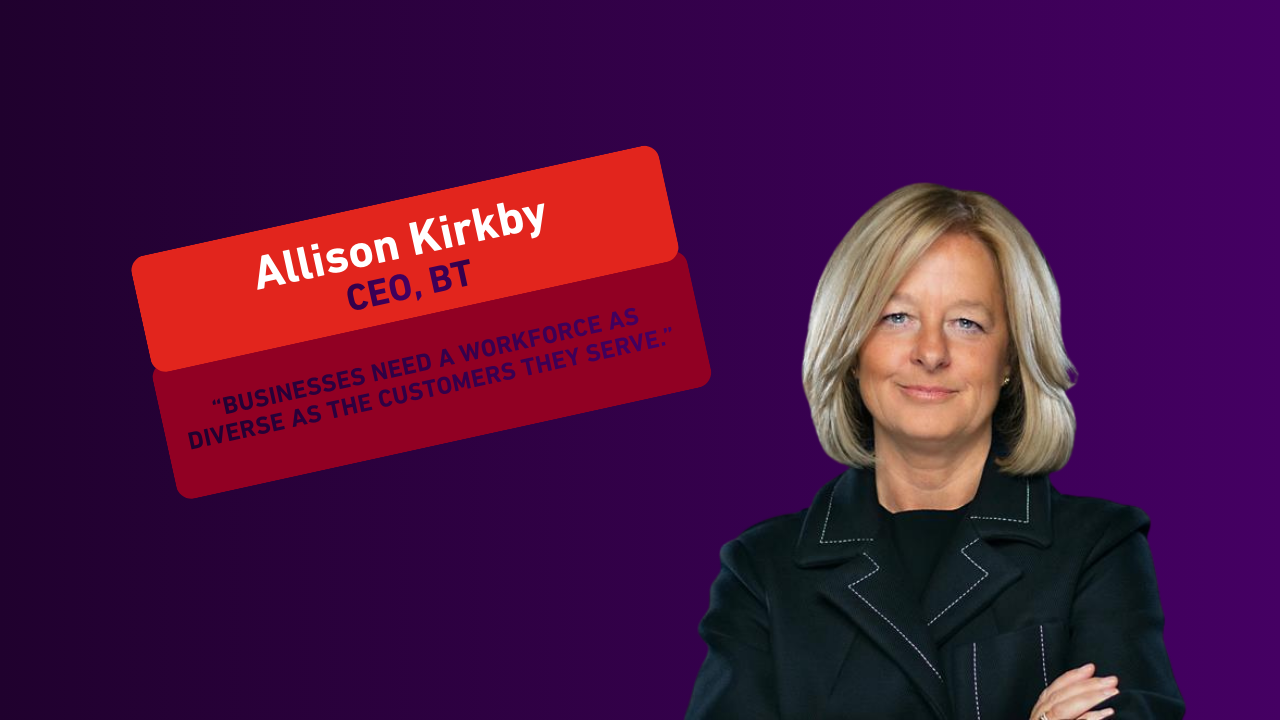
To coincide with International Women’s Day, Allison Kirkby, CEO of BT, shares her perspectives on how inclusion drives business performance with Savannah’s Ali Palmer.
Inclusion as a Commercial Imperative
International Women’s Day this year centres on Give to Gain. BT is explicit about linking inclusion to productivity, innovation, and growth. From your perspective as CEO of BT Group, where have you seen that link most clearly in practice, and where do organisations still underestimate it?
“I have a principle that to be successful, businesses need to have a workforce that is as diverse as the customers they serve, so they can deeply understand their customers’ needs, and that they are designing future product and service roadmaps in line with the changing needs of their customers.
I see this link most clearly happening every day in our customer-facing sales and service teams. The best teams have the gender, ethnic and age diversity of their customers, which helps put customers at ease, especially those who are more vulnerable, when they see and hear someone who looks and sounds like them.
Too many organisations still underestimate this, seeing inclusion as a nice-to-have, rather than recognising it as a driver of customer satisfaction, customer loyalty, revenue growth and productivity.”
Leadership Development and the “What” vs the “How”
BT has invested in shaping leadership behaviours, not just policies, including initiatives designed to prompt reflection and action. Looking back on your own career, what was the most consequential piece of advice someone gave you, and how does that influence the behaviours you now expect from leaders?
“My foundational years were spent at Procter & Gamble, who had a promote-from-within policy, meaning they never had the luxury to go outside of the company to hire in experience and senior leadership. They were also pioneers at encouraging gender and ethnic diversity in their workforce, as they saw it as a business imperative.
Both of these policies meant that leaders were assessed on both their business results and their organisational results, meaning how they developed others as well as themselves.
As part of the annual performance review, you had to seek out broad-based and balanced 360-degree feedback on how you were delivering against both your business and your organisational goals. That feedback had to identify three strengths and three development areas.
This balanced approach to feedback on both the “what” of the business results and the “how” of the organisational results forced everyone to recognise that even the most exceptional leaders had development areas that could make them better leaders of the teams they led, and better coaches of future leaders.
The learning from this was that the best feedback has a balanced mix of strengths and development areas, focused on both the “what” and the “how”, helping both the business and the organisation perform better.”
Systems vs Judgement in Talent Decisions
BT talks openly about building inclusion into its operating systems, from data collection to people manager capability, while recognising the limits of what can be measured. From your experience, which systems make the biggest difference, and where does judgement still matter most?
“In my experience, the systems that make the biggest difference are those that bring visibility, particularly data around performance, progression, succession planning, and people manager capability among minority cohorts relative to the wider workforce. They help you see patterns, challenge assumptions, and ask better questions about where talent is getting stuck or overlooked.
I would also add that sponsorship and mentorship systems are important. Some of the most important moments in my own career wouldn’t have shown up in any data set.
Early on at Procter & Gamble, I was backed for opportunities before I was the obvious choice. A leader used judgement, not metrics, to sponsor me, push me out of my comfort zone, and give me visibility. That decision made a lasting difference.
Systems can highlight gaps, but inclusive leadership is ultimately about the culture of the company and the choices leaders make within it — who they back, how they develop others, and whether they are willing to take thoughtful risks with talent, especially diverse talent.”
The Risk of Overestimating Progress
Where do you think organisations most often overestimate progress with inclusion, and what risks does that create at Board or Executive level?
“I think organisations most often overestimate progress when they focus on representation at a single point in time, rather than the strength of the pipeline behind it.
It’s relatively easy to improve the picture at the top. It’s much harder to change the systems that consistently develop and promote diverse talent over time.
The risk at Board and Executive level is a false sense of confidence. Leaders believe inclusion is progressing when, in reality, succession plans remain narrow and critical roles are still being filled from a limited pool.
When that happens, decision-making becomes less resilient and organisations are exposed when leaders move on or when the context changes quickly.
Real progress shows up not just in who is around the table today, but in whether there is a genuinely diverse group of leaders ready to step into the most senior roles tomorrow.”
Building Future Leadership Pipelines
BT’s reporting makes a clear distinction between representation today and leadership pipelines for the future. From a CEO perspective, how critical is it that inclusion is embedded into succession planning, and what do organisations risk if they treat it as a hiring issue rather than a pipeline issue?
“From a CEO perspective, embedding inclusion into succession planning is critical.
If inclusion is treated primarily as a hiring issue, organisations end up making short-term fixes rather than building the long-term capability needed to nurture an inclusive workplace. Without diverse pipelines, leadership teams narrow over time, just when businesses need broader thinking and better judgement.
Early in my career at Procter & Gamble, I wasn’t developed with a single role in mind. I was developed as part of a pipeline to create the leaders of the future from within.
I was given stretch roles, visibility and sponsorship over a number of years, often before I looked like the obvious candidate. That is what enabled me to step into senior leadership roles when the opportunity came.”
Where Leaders Should Focus First
BT’s work in India shows how focusing on retention, flexibility and psychological safety can materially shift outcomes. If a Board or CEO genuinely wants to “give to gain”, where should they focus first: attraction, progression, or retention, and why?
“First, organisations need to build the case for a more inclusive workplace, coach leaders to spot, develop and nurture diverse talent, and then ensure they have the role models that help attraction and retention and demonstrate that the company is able to progress diverse talent.
In India, it has been particularly important to coach male leaders on how to lead a diverse team, as many are first-generation leaders of a more diverse workforce.”
What Real Progress Looks Like
Looking forward five years, what evidence would tell you that an organisation has genuinely embedded inclusion into how it leads and plans for the future, rather than simply improving its reporting?
“Looking ahead five years, I believe the strongest evidence won’t show up in a report. It will show up in the company’s culture and behaviours, and in how the organisation has visibly changed at every level — with diversity across the organisation and a strong leadership pipeline.”