


Generative AI is reshaping how leaders build stronger teams. It is expanding where organisations look for talent, uncovering high-potential individuals in unexpected places, and enabling faster, more informed hiring decisions.
In a recent webinar, Alex Martin and James Davies-Love explored how these shifts are changing leadership hiring in practice. The session highlighted a clear theme: organisations that rethink how work and hiring workflows operate with AI are building better teams, faster.
AI is transforming workflows, not just speed
Most organisations use AI to make individual tasks faster, including writing, analysis, or research. The real shift, however, is deeper. AI enables leaders to redesign entire workflows by changing when decisions are made, how work is sequenced, and where value is created.
Research shows that companies applying AI across workflows, not just tasks, see significantly better outcomes, from increased productivity to faster revenue growth. Incremental automation delivers limited gains, while workflow redesign creates compounding impact.
The new bottleneck: decision making, not execution
As AI increases output without increasing headcount, the constraint shifts. Execution becomes easier, but decision-making and coordination become the limiting factors.
High-performing organisations respond by improving how decisions are made, using better data, clearer prioritisation, and stronger alignment. For leaders, this means building teams that are not just capable of delivery, but capable of making high-quality decisions quickly.
Why traditional hiring falls short
Executive hiring processes are often slow and misaligned. Common issues include overly rigid role briefs, unclear priorities, and limited visibility into the real talent market.
Too often, key insights such as how rare a skillset is or whether the role is realistically scoped emerge too late. The result is wasted time, smaller candidate pools, and in many cases failed searches due to misalignment.
How AI improves hiring workflows
AI enables leaders to bring critical insights forward. Instead of progressing in a linear way, teams can analyse talent markets early, assess skill overlap, and refine requirements in near real time.
This leads to:
- Faster alignment between stakeholders
- Data-driven role calibration
- More relevant and diverse candidate pipelines
- Shorter and more efficient hiring cycles
By redesigning the workflow, organisations can reduce hiring timelines by several weeks and improve outcomes.
Where AI talent comes from
One of the biggest challenges in building AI-enabled teams is understanding where the right talent actually sits. AI expertise does not come from a single, obvious pipeline. It spans multiple backgrounds and capability areas.
Broadly, AI talent falls into five archetypes:
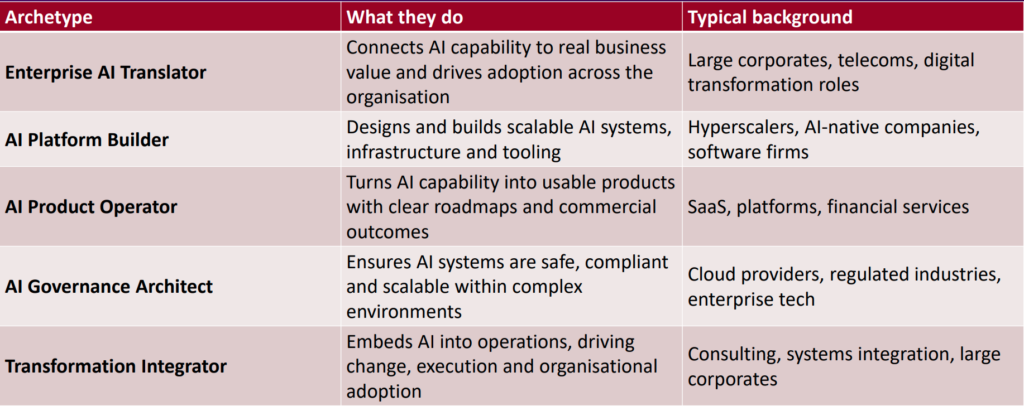
Each archetype typically emerges from different environments, including large corporates, consulting firms, hyperscalers, and AI-native companies.
For leaders, the key question is not just “Who is the best AI candidate?” but “What type of capability do we actually need?” Misalignment at this stage is a common reason searches fail or underdeliver.
Rethinking talent strategy in the age of AI
Hiring for AI, and building better teams more broadly, requires a shift in mindset. Leaders need to move from rigid role definitions to a more flexible, insight-led approach.
The most effective organisations do not just run hiring processes faster. They:
- Start with a clear understanding of the talent market
- Define roles based on real capability needs
- Partner closely with recruiters as strategic advisors
- Continuously refine their approach using data
AI makes this possible. When used well, it transforms hiring from a reactive process into a strategic advantage, helping leaders build stronger and more aligned teams, faster.
To discuss this further please contact Alex Martin or James Davies-Love.