

TA leaders are being pulled into strategic territory that demands new thinking, new tools, and new levels of influence. Below is a distilled summary of the collective themes, tensions, and opportunities that emerged from Savannah’s recent TA Forum.

Strategic workforce planning
Everyone is trying, no one has ‘cracked it’.
- Long-term plans quickly become obsolete due to market shifts, regulatory change, political variables, M&A activity, and unexpected technology disruption.
- Most strategic workforce plans end up becoming demand plans, rooted in present realities, not future requirements.
- Leaders are attempting to balance horizon planning with rapid decision-making, often without complete data.
Skills: The new currency – but the system is flawed
Skills taxonomies sound good in theory, but are proving too heavy, too slow, and too fragile.
- The half-life of skills continues to shrink.
- The real competitive differentiator is learning agility, not a perfect skills inventory.
- Emerging trend: moving from skills mapping to potential mapping: “who can become what, and how fast?”
Internal vs External – the build, buy or bet decision
Organisations want to develop internal talent but are still defaulting to external hiring, often due to speed, pressure, and confidence.
- Some leaders now question whether developing out of current skill gaps is viable, especially in highly specialised areas.
- Internal mobility is often under-powered due to weak insight, unclear readiness, and manager bias.
- Internal promotions can be harder than external moves — rebranding internally is a real and underestimated barrier.
External market intelligence matters – but data alone isn’t the answer
Most organisations are drowning in information and starving for insight. Benchmarking is increasingly being used not just for hiring, but to validate organisational design and succession decisions.

AI & Technology: democratise, don’t centralise
AI is shifting from specialist capability to universal productivity expectation.
- Organisations are expanding AI tools (e.g. Copilot) across broad employee populations rather than concentrating them in tech functions.
- There is a growing belief that the winners will be augmented, not automated.
- “AI won’t take your job, but someone using AI will. ”
The risk blind spot: contingent workforces
In many organisations, 30–70% of real workforce capacity is invisible.
- Companies often don’t know who contractors are, what they’re working on, or what system access they hold.
- This is becoming a cost, security, and succession risk, and a major blocker to credible workforce planning.
- “If you can’t see it, you can’t plan it – and you definitely can’t secure it.”
Succession: readiness, rotation & reality
There is increasing recognition that traditional leadership succession models don’t match modern business cycles.
- Executive refresh cycles are shorter, making traditional pipelines misaligned.
- The next era of succession looks more like talent portfolio management than linear progression.
Some organisations are now experimenting with:
- Earlier career acceleration
- Dual-ownership roles
- Rotational exposure models
- External benchmarking before internal endorsement
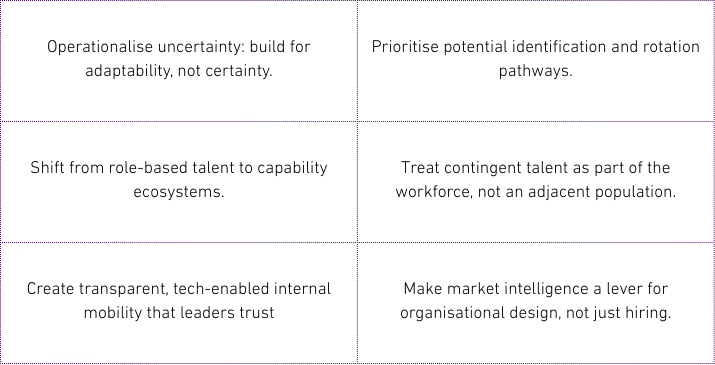
Emerging leadership imperatives for TA executives
To discuss your talent acquisition leadership challenges, please contact Ali Palmer, Katie Chevis, or Rachel Clark.